Streamlining job code changes for managers at Amazon
ENTERPRISE HR SOLUTIONS
At Amazon, a "job code change" occurs when an employee transitions to a new role—such as a UX Designer shifting roles to become an Applied Scientist.
While a key opportunity for lateral career growth, this HR process was previously fragmented across 6 disconnected tools, causing massive operational friction for managers and a low 69.7% policy compliance rate. Furthermore, the legacy tool had a planned deprecation and the team had a deadline to migrate the workflow into the Amazon central employee portal.
As a Lead UX Designer on the Amazonian Career Events team, I consolidated these disjointed systems into a single, intuitive, wizard-style workflow. This unified experience automatically surfaces system data, provides dynamic pathing, and bakes validation rules directly into the UI—successfully driving policy compliance from 69.7% to 100% across 41.1K annual transitions.
Expertise
UX Research
Usability testing
Designing for scalability
Project Details
Context: Human Resources, Talent Management
Role: Lead UX Designer
Timeframe: 6 months
Key Collaborators
Jodi Osmond
Kate Wharton
Keri Stenerson
Challenge
A broken, high-risk system
When an employee changes roles while staying on the same team, the manager must submit a request for a job code change as part of Amazon HR policy. This process is typically straightforward, but when the employee is changing roles into a new job family, a review process is required to validate their skills for the new position.
Job code changes occur about 41,100 times per year, with ~7,900 requiring formal skills assessments due to a job family change.
The legacy process was entirely fragmented across forms, approval systems, help articles, email, and Word doc templates. Because tools didn't talk to each other, users faced massive friction:
Managers were left in the dark: Few managers could find out how to properly do a job code change. A major bottleneck for changes that required an assessment was finding qualified skill assessors; one manager sent 100+ manual invites to receive just 3 responses.
HR Partners used manual work-arounds: HR partners were constantly fielding requests from confused managers and manually resolving tickets, adding to their workloads when a self-service option should have been sufficient.
Business Risk: The legacy tool that facilitated job code changes was facing deprecation, and with a 69.7% compliance rate to HR policy, nearly a third of all role changes bypassed proper review—creating immense organizational risk.
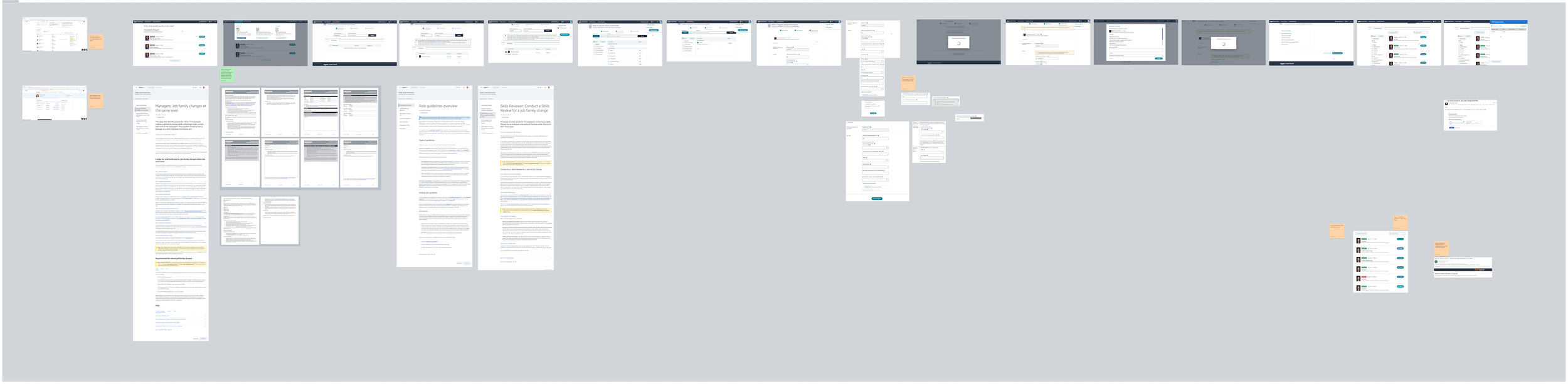
A UX audit of the legacy process revealed many disjointed tools and scattered information
Approach
Understand, then simplify the work for managers
To ground the cross-functional team before diving into design, I launched a rapid qualitative study, interviewing 6 internal participants (3 managers, 3 HR partners) who had navigated 10+ recent job code changes.
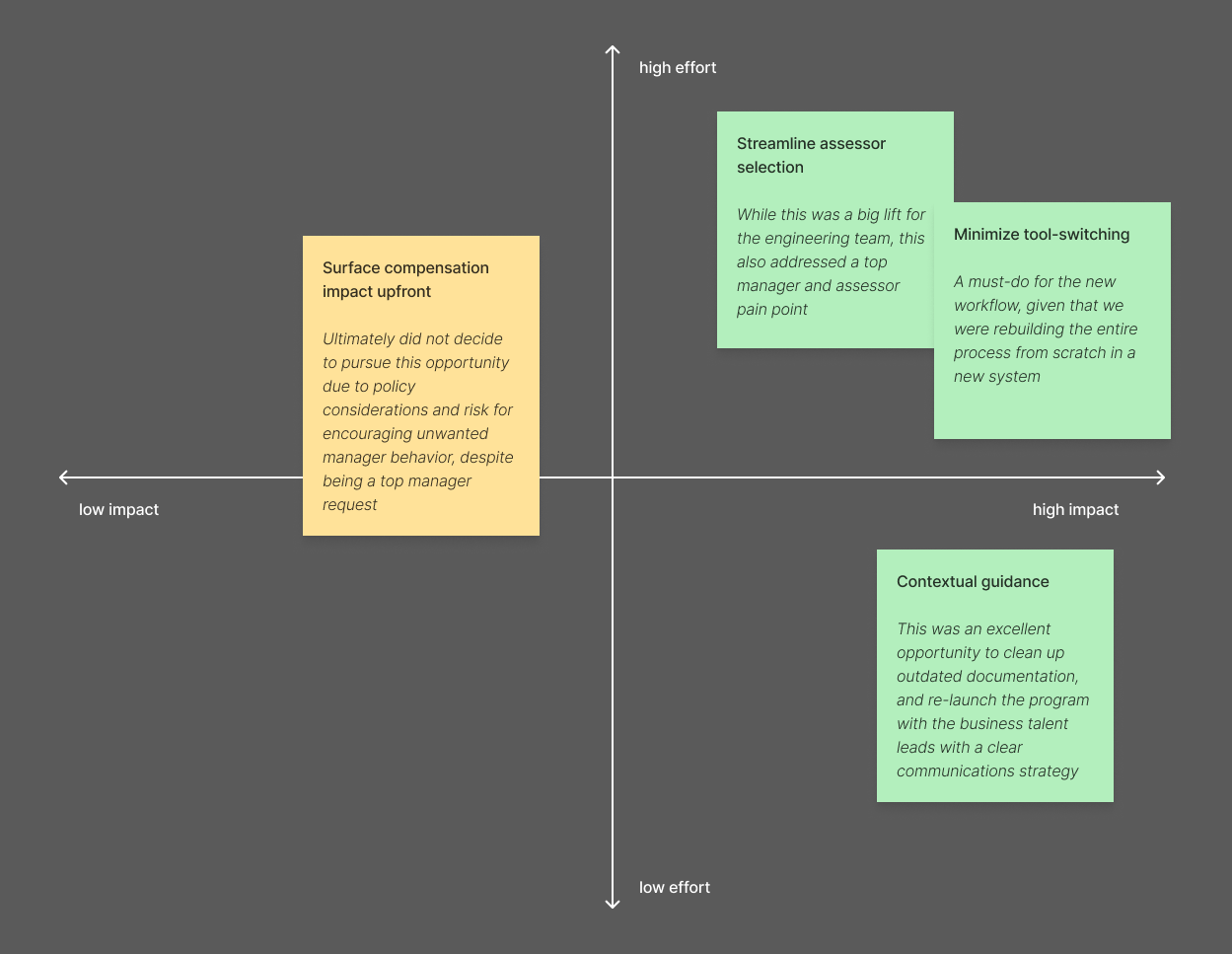
The research uncovered four distinct design opportunities:
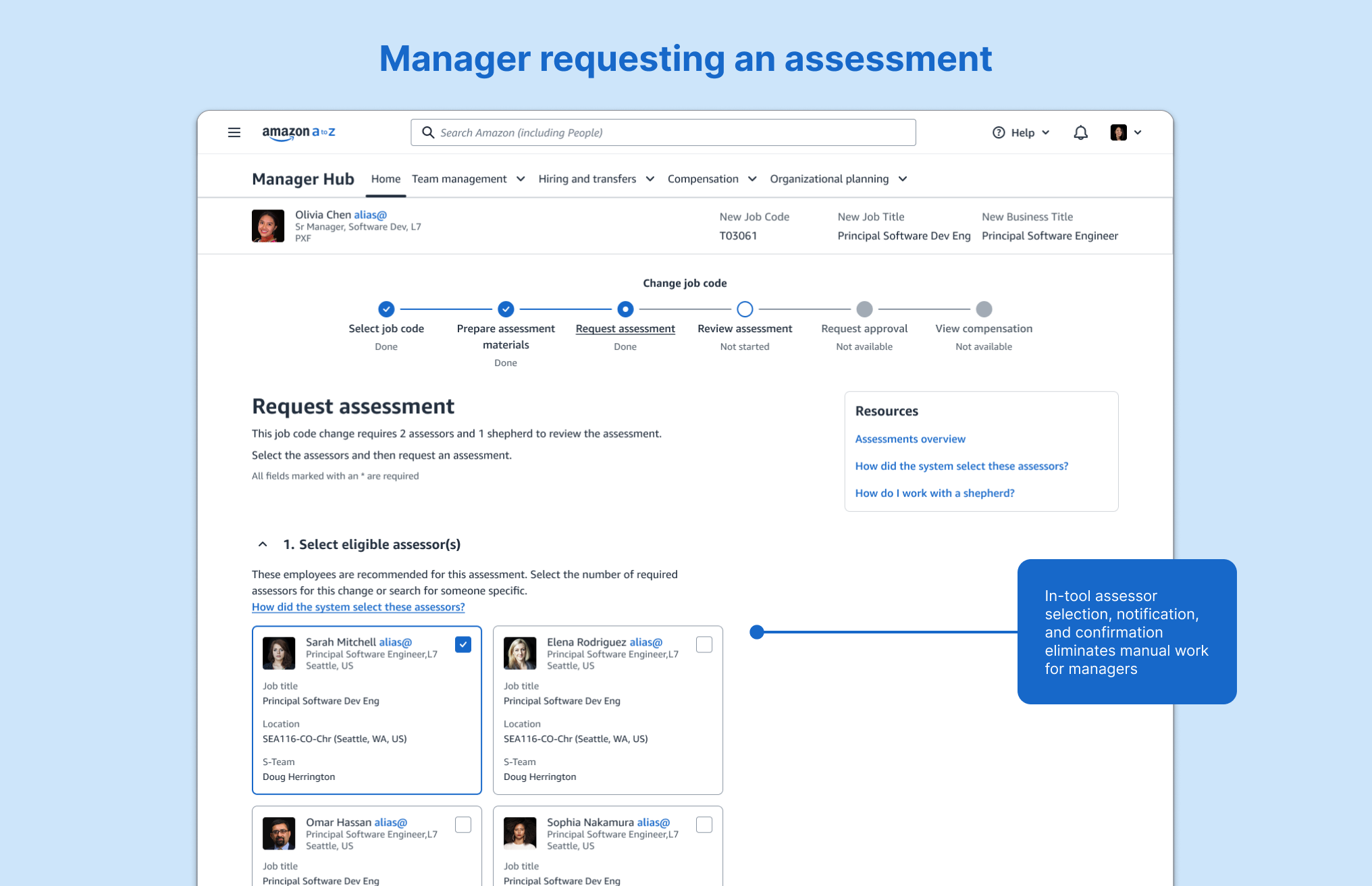
Streamline Assessor Selection: Eliminate the manual "guesswork" and cold-outreach bottleneck for finding reviewers.
Minimize Tool-Switching: Bring disjointed manual tasks completely into a single interface.
Surface Compensation Impact Upfront: Give managers visibility into pay impacts before submitting for final approval to avoid costly re-work.
Contextual Guidance: Provide dynamic, in-line support so users don't have to seek out external help documents.
To move quickly under a compressed 4-month timeline for the initial launch, the product manager and tech lead and I aligned around three core design tenets: Do no harm, keep it Seamless, and keep it Efficient.
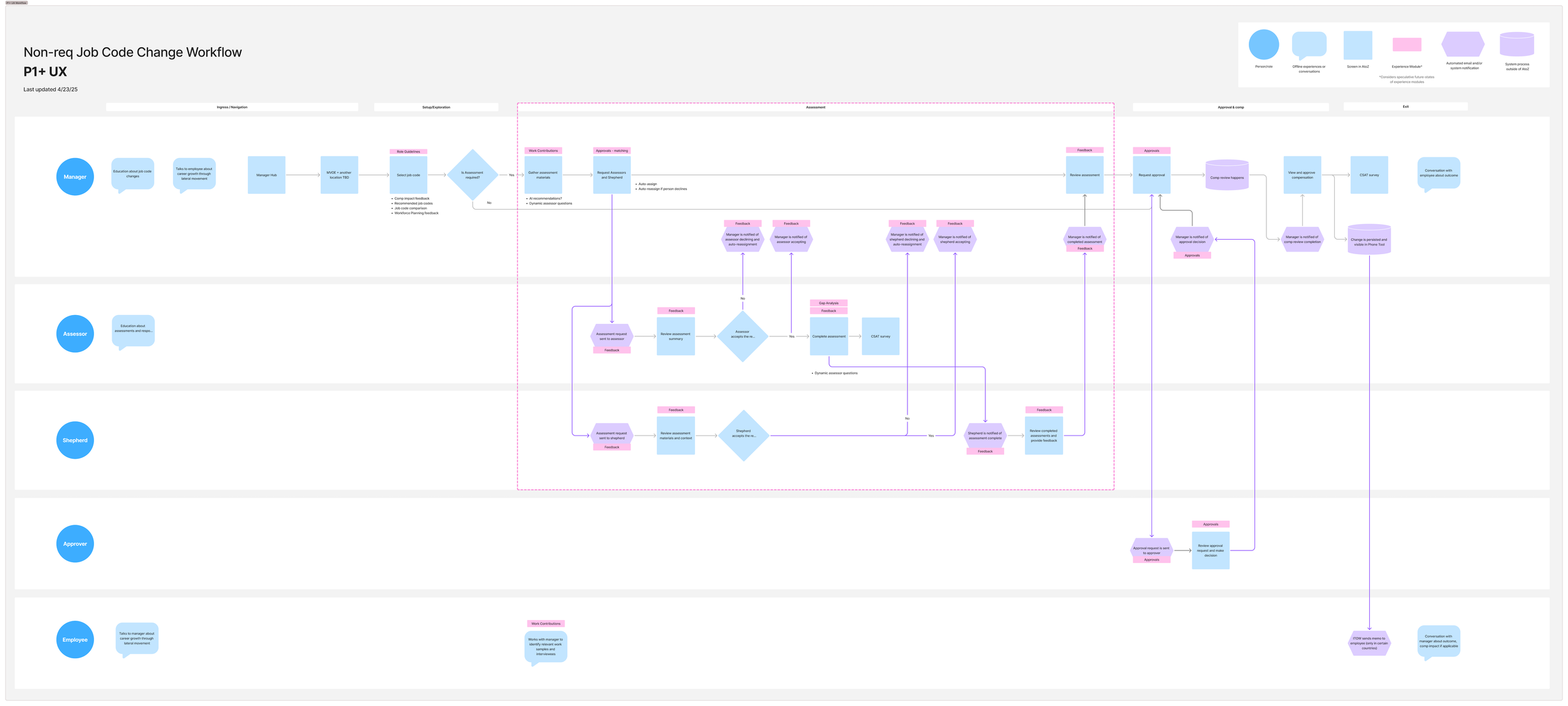
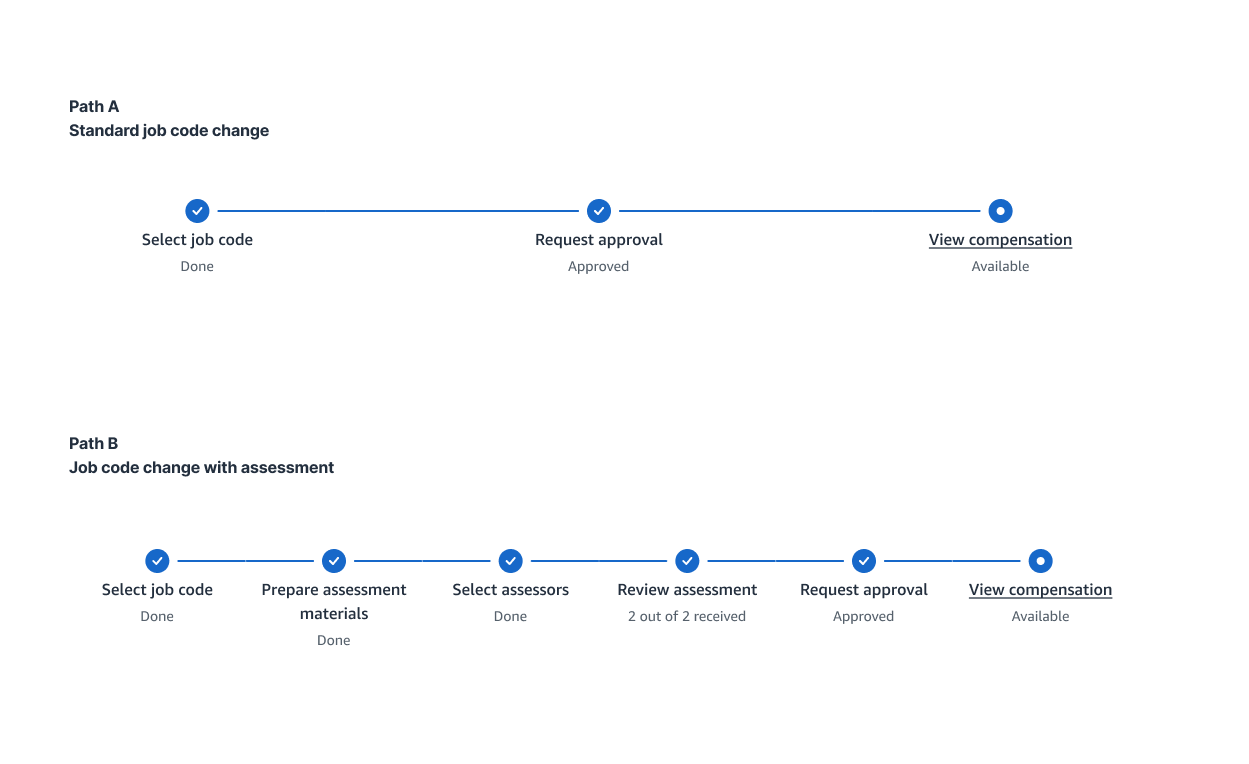
The experience needed to elegantly handle two vastly different user paths without confusing the user:
Path A: Standard job code changes that require no assessment (~33,200/year).
Path B: Complex transitions requiring a formal skills assessment (~7,900/year).
Solution
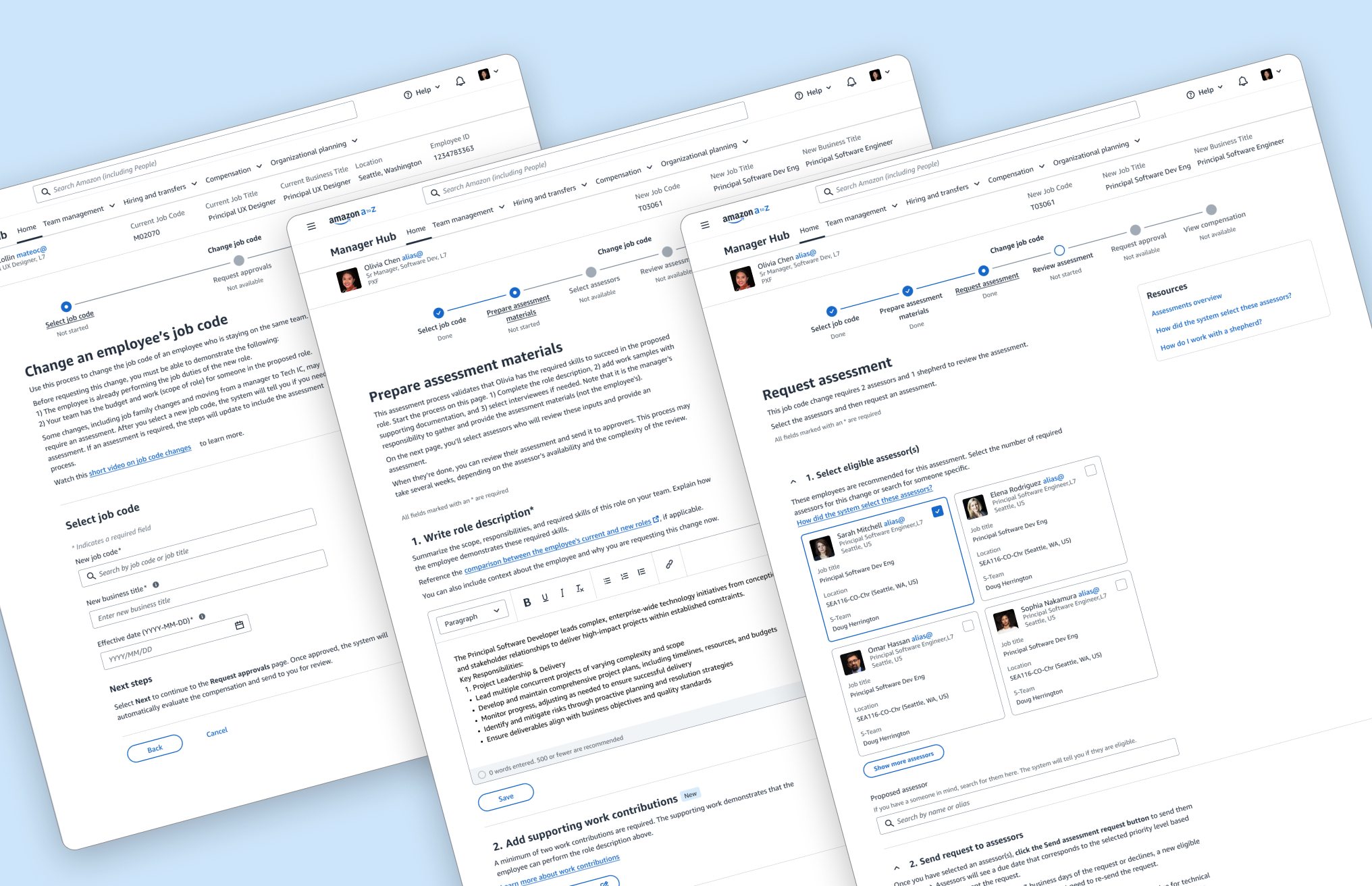
The dynamic workflow
Outcome
The final design replaced the multi-tool chaos with a single, connected, wizard-style workflow. To validate and iterate on features before production, I led 3 rounds of usability testing (with 14 managers and 17 assessors across P0 and P1 phases).
Feature highlights
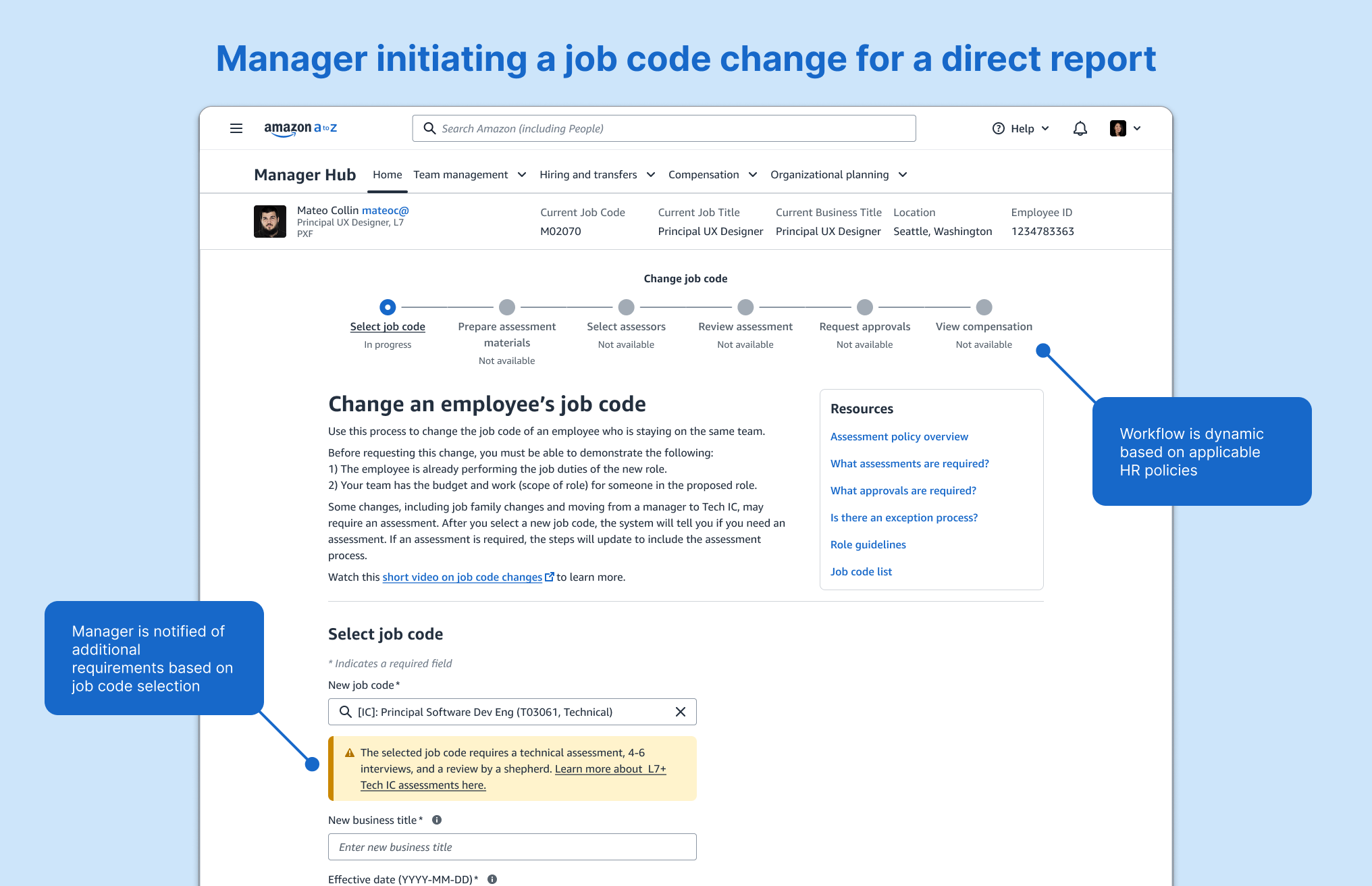
The new job code change workflow was successfully launched globally ahead of the planned deprecation of the legacy HR tool, leading to a smooth transition to the new workflow.
Business impact
Tool Consolidation: Tools reduced from 6 fragmented systems to 1 unified workflow.
Policy Compliance: Boosted HR compliance from 69.7% to 100% through structural validation.
Speed to Market: Designed, tested, and shipped the core P0 framework on schedule.
Beyond resolving the immediate friction for 41.1K annual transitions all corporate job code changes within Amazon , the skills assessment workflow was adopted as the foundation for the enterprise's new Assessments Module. The UX framework I designed is now being scaled across the organization to standardize technical promotions and internal team transfers.
In subsequent iterations, I designed and launched the integration of an AI-powered gap analysis of an employee’s skills to the target role and component for tracking employee work contributions.
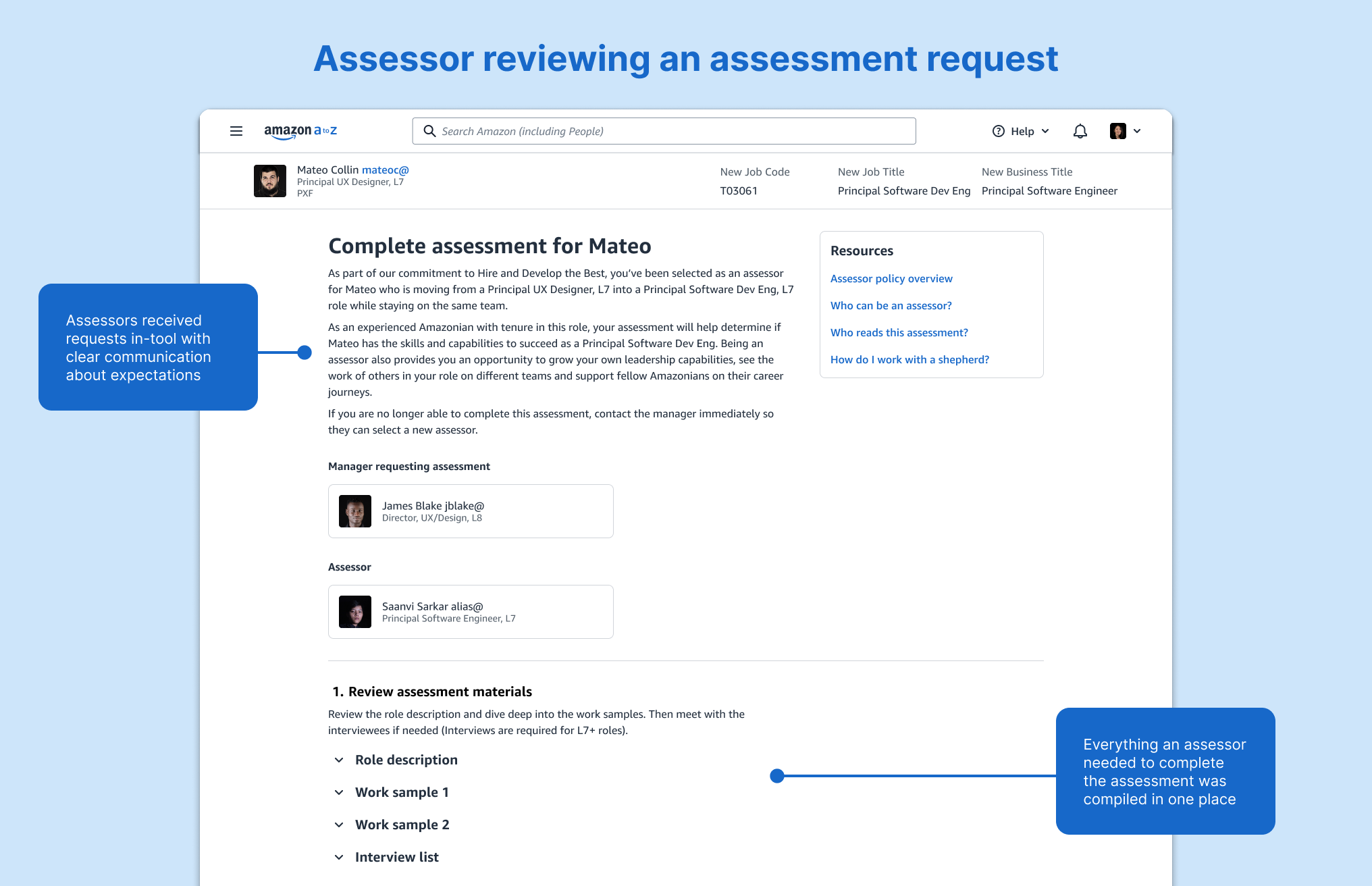
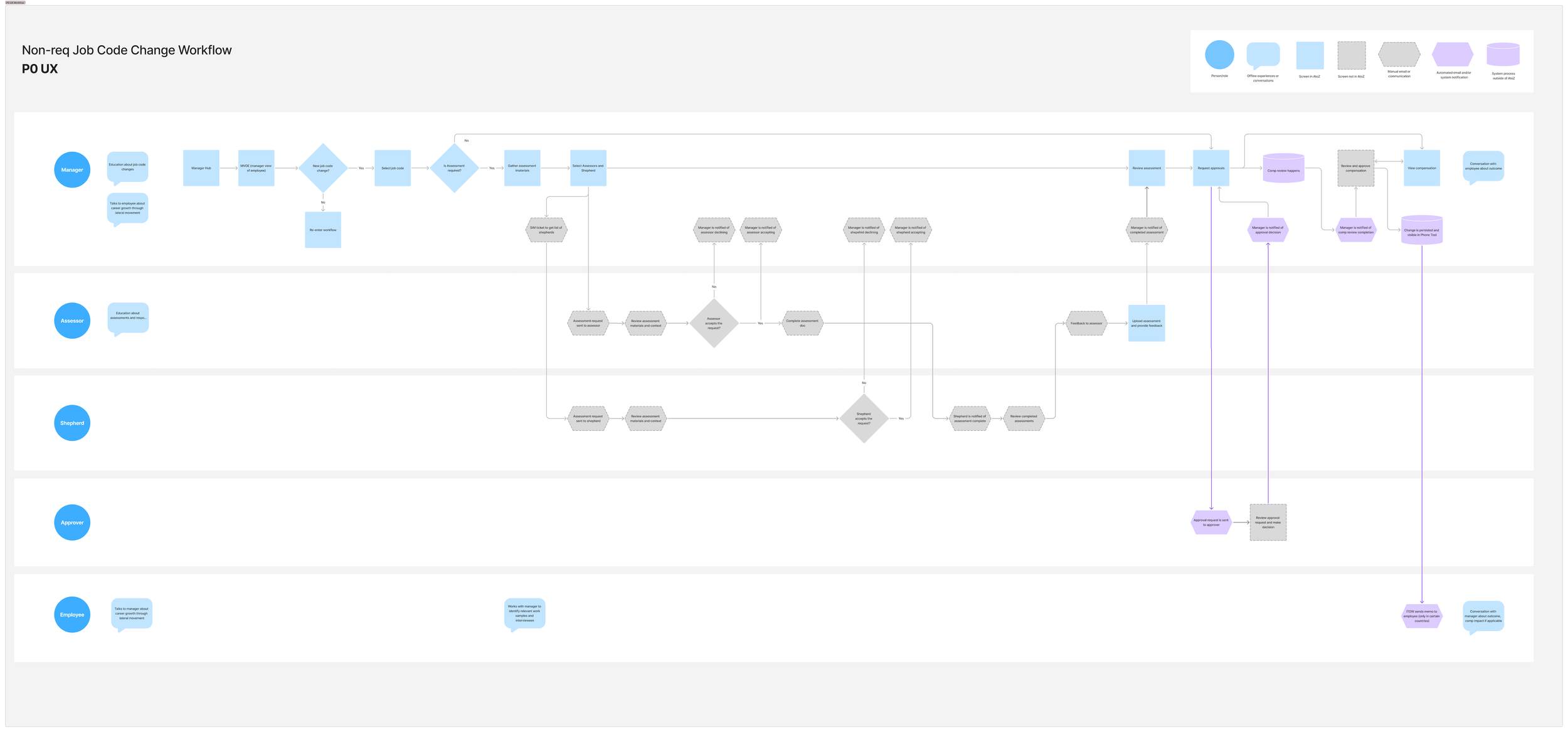
The P0 launch brought all the standard job code change (path A) steps into one connected workflow across 5 personas, with some of the assessment steps (path B) still required offline processes due to technical bandwidth.
The P1 launch and subsequent planned launches brought the remaining offline processes into the tool, integrated several re-usable modules from across other talent workflows, and set the foundation for a new re-usable assessments module.